Connecticut Financial Literacy Standards and Policy Ranking

The Connecticut Financial Educators Council (CTFEC) is the state advocacy chapter of the National Financial Educators Council (NFEC). Our role is to advance policy, standards alignment, and statewide action to ensure that Connecticut students graduate prepared to manage real-world financial decisions.

The NFEC conducts national research and develops academic standards. CTFEC translates that research into policy advocacy specific to Connecticut. Our shared mission is to ensure that all learners graduate prepared to navigate real-world financial decisions by elevating financial education to the same level of quality, accountability, and instructional integrity as other required core academic subjects.
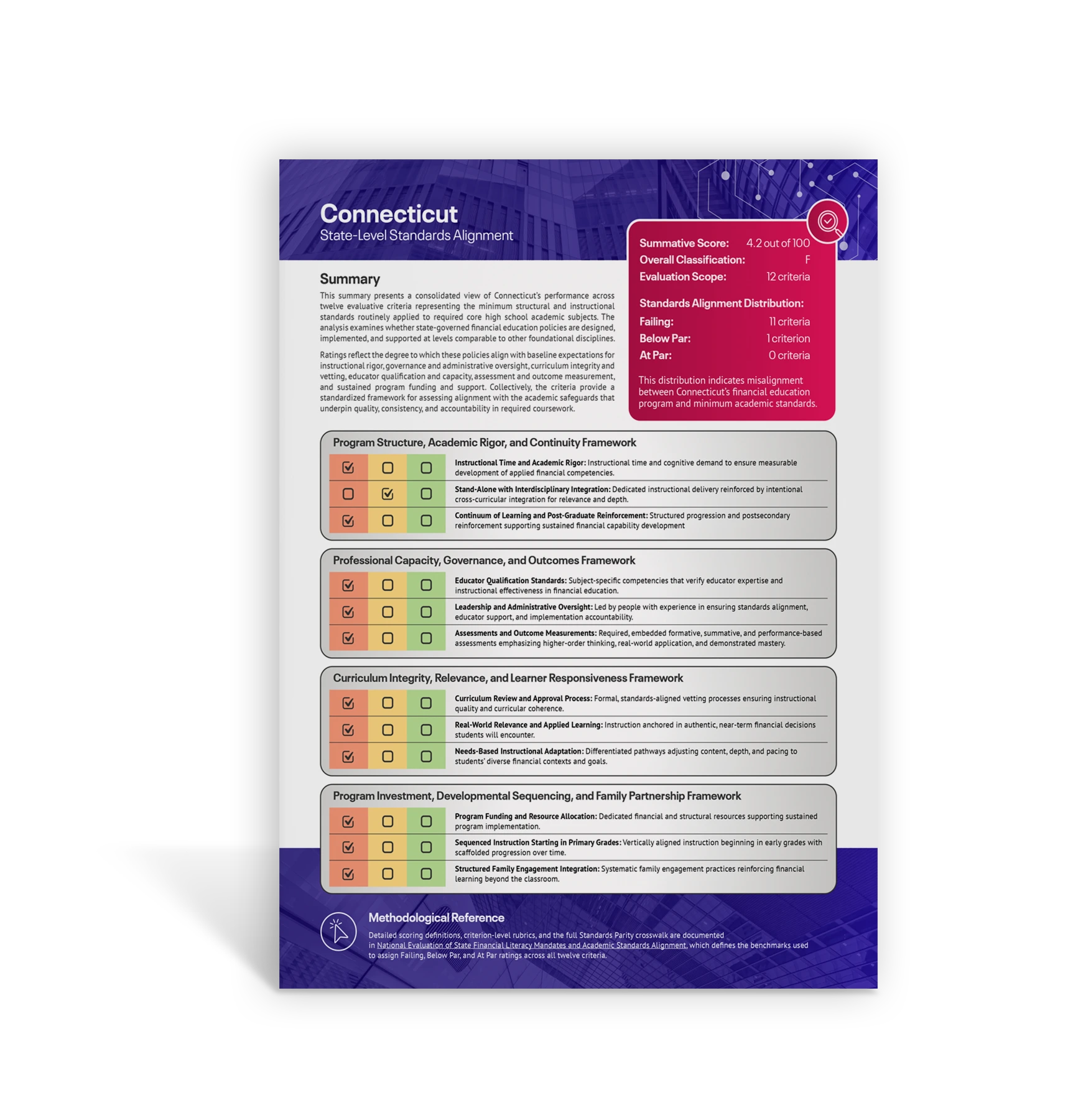
Connecticut Financial Education Standards Alignment: A State-Level Policy Assessment

Drawing on research conducted by the NFEC, Connecticut’s financial education system appears misaligned with the baseline academic standards generally expected of core high school graduation requirements. Using a standardized 12-criterion framework applied uniformly across all 50 states, the NFEC evaluated whether state-led financial education policies meet fundamental benchmarks in areas such as instructional rigor, governance, curriculum integrity, educator readiness, assessment protocols, and sustained program support.

Under this assessment, Connecticut received a total alignment score of 8.3 out of 100 and was given an overall classification of Failing. Of the 12 criteria evaluated, 10 were rated as Failing, while 2 fell into the Below Par category, and none met At Par standards. Collectively, these findings point to a significant gap in the presence of key policy elements typically embedded in established academic subjects, suggesting that Connecticut’s financial education framework lacks the structural capacity to provide consistent, rigorous, and accountable instruction comparable to disciplines such as mathematics, science, and English/language arts.

Connecticut Financial Education Assessment

CTFEC’s Advocacy Focus in Connecticut

CTFEC works to ensure that financial education is treated as a core academic subject rather than optional enrichment. Our advocacy is organized to advance priorities that align Connecticut’s policy environment with established academic expectations.


Research & Policy Guidance

CTFEC promotes financial education policies aligned with core academic standards, emphasizing clear outcomes, educator preparedness, and accountability. Grounded in national research, CTFEC works with educators, community leaders, and policymakers to identify gaps, evaluate legislation, and support scalable, standards-aligned implementation.

Standards for Financial Educators and Learners

CTFEC supports the adoption of comprehensive learner outcome standards and educator competency frameworks to strengthen instructional quality statewide. By providing clear benchmarks for what students should know and be able to do – and what educators must demonstrate to teach effectively – CTFEC helps establish consistent expectations that support long-term financial capability development.

Closing Statement

Connecticut’s students deserve more than exposure to financial concepts; they deserve real preparation for the financial decisions that shape adulthood. These findings reveal a clear opportunity to strengthen financial education by aligning it with the rigor and accountability applied to other core subjects.

By advancing standards-based reform and investing in quality implementation, Connecticut can ensure that every student graduates financially prepared for life beyond high school. Meaningful progress requires collective action from educators, families, policymakers, and community leaders – working together to make financial education a foundational part of a future-ready education system.

National Financial Educators Council

Connecticut Department of Education – Personal Financial Management & Financial Literacy

Connecticut Personal Financial Management & Financial Literacy Standards (Performance Elements & Indicators PDF)

Public Act 23-21 / SB 1165 full legislation text (PA 23-21 PDF)

Connecticut requires students to complete a half-credit financial literacy course to graduate (class of 2027 and beyond).

Personal financial management and financial literacy are now part of the required program of instruction.

Connecticut has financial literacy standards/performance elements but broader K–12 standards are not fully defined across all grade bands.

State chapters

National Evaluation of State Financial Literacy Mandates and Academic Standards Alignment

State-Mandated Financial Literacy Standards: A Comprehensive National Review

Financial educator credentialing

Certified financial literacy professional

How to teach personal finance to high school students

Financial Literacy Standards in Connecticut

As of 2026, Connecticut requires a half-credit personal financial management and financial literacy course for high school graduation, beginning with the class of 2027. This requirement was enacted through Public Act No. 23-21 (SB 1165, signed June 7, 2023), which added personal financial management and financial literacy to the state’s required program of instruction for public schools. Students must complete this half-credit course, which can count as either a humanities or elective credit, to earn a diploma. Source.

While this represents progress in guaranteeing exposure, the mandate has notable weaknesses compared to core academic subjects. There is no dedicated statewide funding for implementation, no mandated teacher training or qualifications specific to financial literacy, and no required accountability system for measuring student outcomes (e.g., assessments or performance indicators). Districts rely on voluntary resources and limited professional development, leading to potential inconsistencies in instructional quality and depth across the state. These gaps risk limiting the program’s long-term effectiveness in building meaningful financial capability. Source.

As of 2015, the Constitution State had earned a grade of “F” for its public school financial instruction standards. This finding was posed by the Champlain College Center for Financial Literacy, which compiles a state-by-state National Report Card biannually. Personal finance concepts are not required to be taken or taught as graduation requirements in Connecticut schools, either in a standalone course or embedded in other classes.

Still, the Constitution State had made some strides toward establishing guidelines that may have improved that grade. The Connecticut Department of Education built educational frameworks that would help educators develop courses to include personal finance topics. In 2015, the state enacted a law requiring the State Board of Education to make financial literacy curriculum available and provide related materials and assistance to school districts. Through an agreement with the Banking Department, the State of Connecticut awards grants to school districts to present personal finance instruction online or through traditional courses in Connecticut high schools.