
Connecticut Financial Literacy Statistics
The Connecticut Financial Educators Council (CFEC) researches and documents the financial wellness landscape of state residents. Regular updates ensure that the data shared on this page remain timely and useful. Intended to aid advocacy, policy development, and educational outreach the information supports a broad range of financial literacy stakeholders. The Connecticut Council’s ultimate aim is to keep financial wellness initiatives advancing statewide – and curating these data represents one step in that direction.
Cost of Financial Illiteracy Survey
Connecticuters report that lack of financial knowledge carries a high cost, according to the NFEC’s most recent survey. Participants across the state responded to the single question: “During the past year, about how much money do you think you lost because you lacked knowledge about personal finances?” The results are shown below. Since 2017, the NFEC has conducted this annual survey, consistently revealing that the average individual cost of financial illiteracy approaches or exceeds $1,000 per person – with estimated national losses reaching into the hundreds of billions of dollars each year, and losses in the hundreds of millions across Connecticut.
Cost of Financial Illiteracy
$0 – $499
$500 – $999
$1,000 – $2,499
$2,500 – $9,999
$10,000 +
Financial Vulnerability Among Connecticut Residents
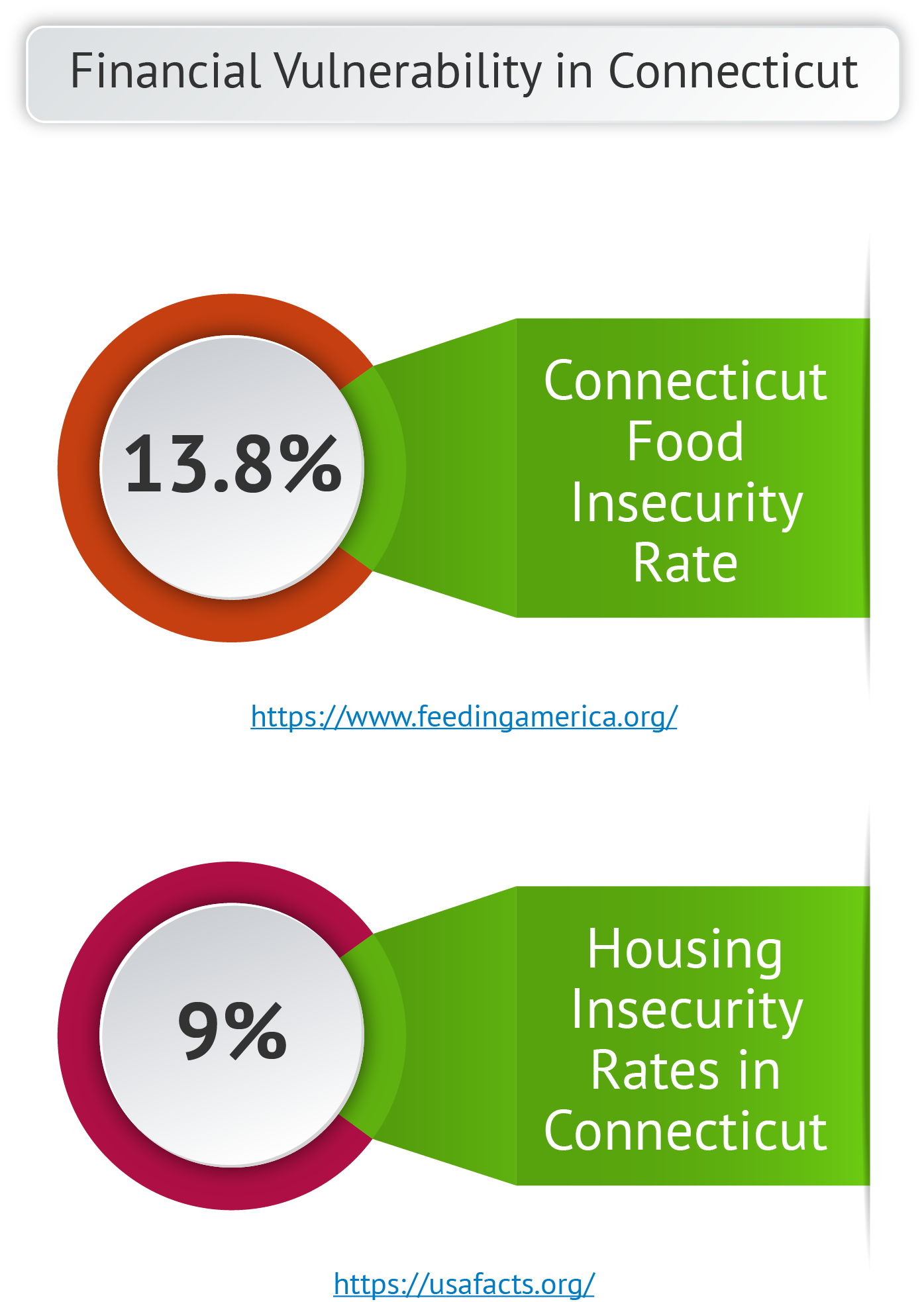
Insecurity in terms of food and housing are the two main indicators of financial vulnerability in America today. The nonprofit organization Feeding America gathers data representing food insecurity in each state. Their most recent report shows that one in seven Connecticuters are facing hunger – 516,640 people in total (13.8%), of whom 122,660 are children. Among those Connecticut households receiving the federal Supplemental Nutrition Assistance Program (SNAP) benefits, 31.4% have children in the home.
Connecticut had a total homeless population of 3,410 as of 2024, translating to a homeless rate of 9%, according to the World Population Review (WPR). More than 500,000 people are unhoused across the U.S. today. The WPR cites the four top causes of the homeless problem (in order) as: lack of affordable housing, unemployment, poverty, and low wages.
Data Revealing People’s Financial Situations in Connecticut
Average Total Consumer Debt
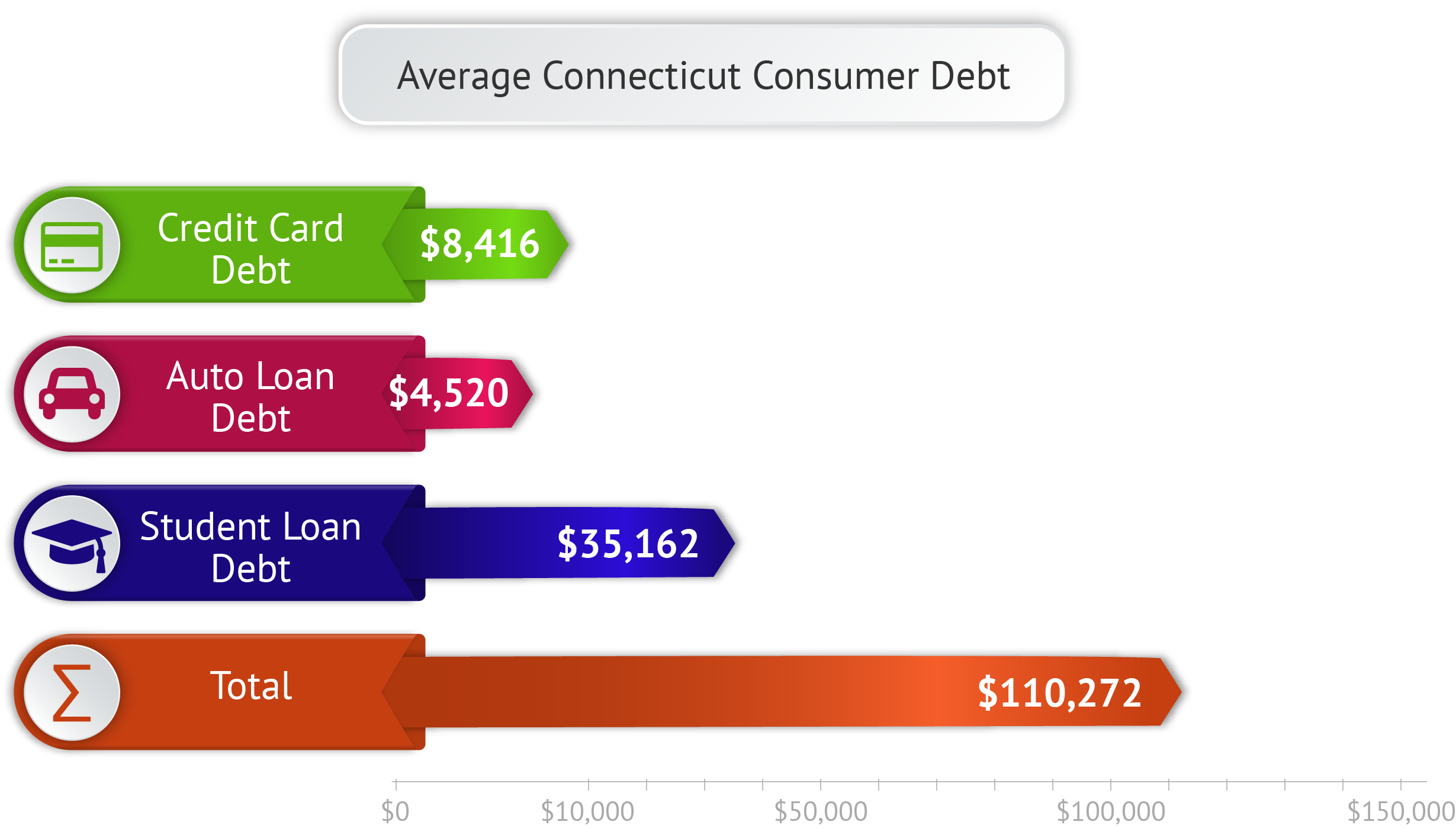
Total consumer debt in the U.S. has reached all-time highs, more than $18.3 trillion as of the end of 2025. Experian data from June 2025 show that Connecticut is part of that trend, with an average total consumer debt per user of $110,272 – above the national average of $104,755. The Connecticut figure had decreased slightly – by –0.7% – since 2024.
Specific Debt Load Levels
More granular data on the Connecticut debt load show that residents with outstanding student loans carry a balance of $35,162 on average, according to the World Population Review. A January 2026 report by WalletHub places the average per-user balance in credit card debt at $8,416 in Connecticut. A further report from the World Population Review calculated that Connecticut residents owed an average $4,520 in auto loan debt in 2024; that amount has probably increased year-over-year.
Statistics on Connecticut Financial Literacy Education and Legislation
The National Education Association (NEA) publishes state-level data characterizing number of schools, teachers, and student enrollment totals for all states in the U.S. In the NEA’s most recent report (2025), 201 public school districts were operating in Connecticut as of the 2023-2024 school year, with total student enrollment of 881,464. Teachers employed by those districts totaled 42,255, for an extrapolated student-to-teacher ratio of 12.1 to one.
Connecticut state legislation related to school financial education includes Public Act 15-138 (Substitute Senate Bill 139), passed in 2015, which provided that the financial literacy curriculum materials the State Department of Education offers to school districts must include materials on banking, investing, savings, and the handling of personal finance matters. The state’s Senate Bill 1165, effective July 1, 2023, mandates that all high school students in Connecticut must complete a one-semester personal finance course starting with those entering the 9th grade in the 2023-2024 school year.